Summary
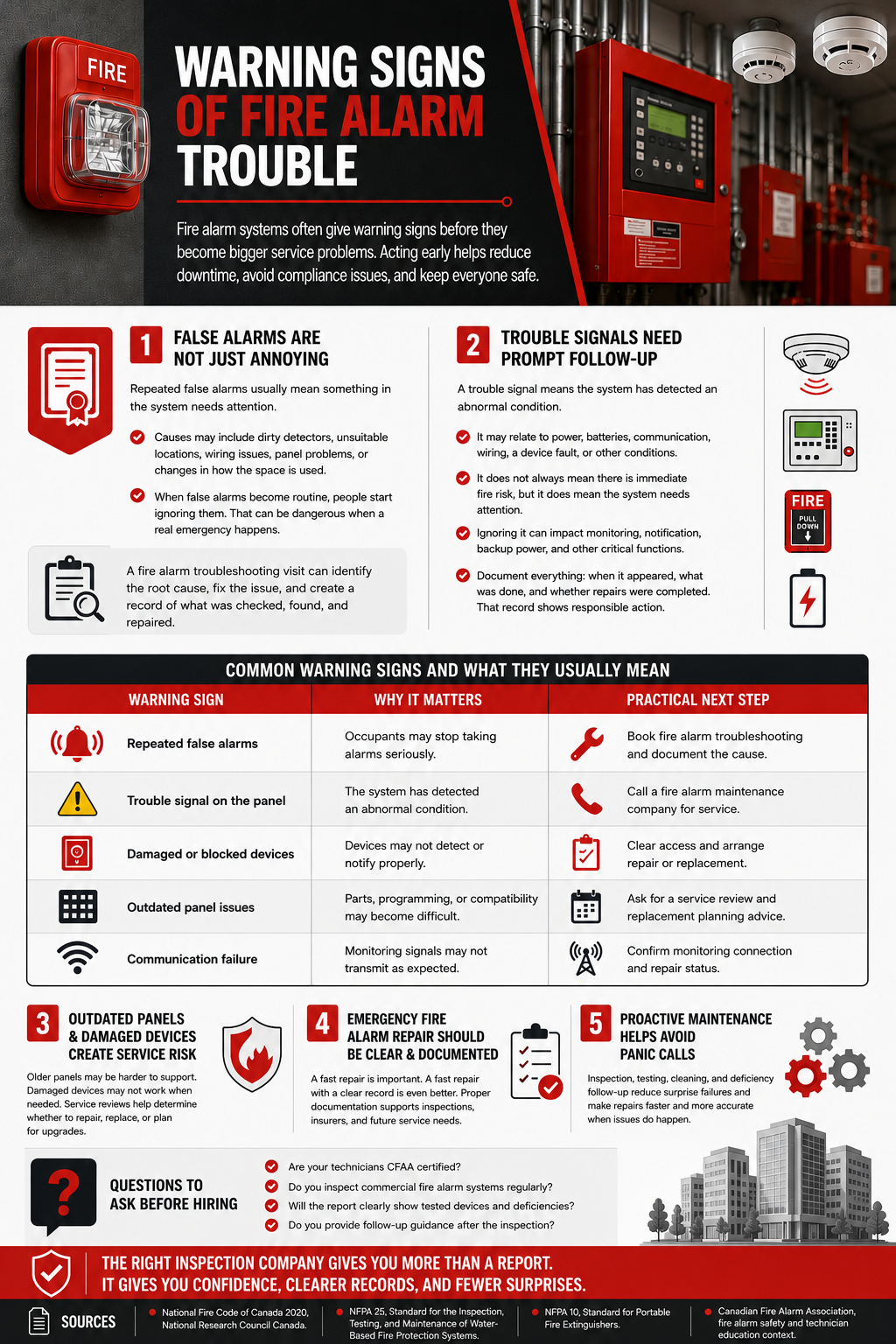
A commercial fire alarm system usually warns you before it becomes a real service problem. False alarms, trouble signals, damaged devices, aging panels, communication failures, and any odd behaviour are all worth taking seriously, even when they seem minor.
And they often do seem minor, especially in a busy building with a dozen other things demanding attention. The trouble is that with fire alarms, small issues have a habit of turning into bigger safety, service, or documentation problems. The faster a building team responds, the easier it is to limit downtime, sidestep compliance headaches, and keep everyone inside protected. Staying on top of it also keeps property managers ahead of emergency calls, inspection surprises, and last-minute scrambling.
A commercial fire alarm system usually tells you it’s in trouble long before it actually fails. The signals are easy to overlook, though. A nuisance alarm here, a blinking trouble light there, a cracked pull station nobody got around to reporting. On their own, each one feels like something you can deal with later.
The catch is that “later” has a way of arriving at the worst possible moment, often during an inspection, an insurance review, or a real emergency. Catching these signs early is almost always cheaper, less disruptive, and a lot less stressful than dealing with them after they’ve grown into something bigger.
Here are the warning signs worth paying attention to, and what they’re usually trying to tell you.
False Alarms Are More Than Just Annoying
When an alarm goes off for no obvious reason, it’s frustrating. It interrupts the workday, rattles tenants, and sometimes empties the whole building over nothing. But a system that cries wolf is rarely doing it at random. Something is off.
The usual suspects are a dirty detector, a wiring fault, a panel issue, or a device that was simply put in the wrong spot. A smoke detector mounted near a kitchen, a loading dock, a dusty storage area, or an HVAC vent is going to trip far more often than one in a quiet hallway. Sometimes the building itself changes around the device. A renovation, a new tenant, or a shift in how a space gets used can turn a perfectly fine detector into a frequent offender.
The real danger isn’t the interruption. It’s what repeated false alarms do to people. Once staff and tenants start rolling their eyes at the sound, they stop moving when it goes off. They assume it’s another glitch. And the one time it isn’t, those wasted seconds matter.
A troubleshooting visit can sort out whether you’re dealing with a single problem device or something wider across the system. Just as importantly, it leaves you with a record of what was found and what needs fixing.
A Trouble Signal Is the System Asking for Help
A trouble signal is your panel’s way of raising its hand. It might point to a power problem, a low battery, a wiring fault, a communication issue, or a specific device that’s misbehaving.
It doesn’t necessarily mean there’s a fire risk in that moment. What it does mean is that some part of the system isn’t operating the way it should, and that part might be exactly what you need during an actual emergency: backup power, monitoring, notification. Leave it alone and you may not find out it’s compromised until it’s too late to matter.
There’s a paperwork angle too, and it sneaks up on people. If an inspector, insurer, or authority having jurisdiction ever asks about that condition, you’ll want to show when it appeared, what you did about it, and whether it got resolved. A clean service record is the difference between “we caught it and handled it” and an awkward silence.
Common Warning Signs and What They Usually Mean
| Warning Sign | Why It Matters | What to Do |
|---|---|---|
| Repeated false alarms | People stop taking alarms seriously | Book troubleshooting and document the cause |
| Trouble signal on the panel | The system has flagged an abnormal condition | Call a fire alarm maintenance company for service |
| Damaged or blocked devices | The device may not detect or alert properly | Clear access, then arrange repair or replacement |
| Outdated panel issues | Parts, programming, or compatibility get harder | Ask for a service review and an upgrade plan |
| Communication failure | Monitoring signals may not transmit | Confirm the monitoring connection and get it repaired |
Aging Panels and Damaged Devices Are Quiet Risks
An older fire alarm panel isn’t automatically a problem. Plenty of them run reliably for years with proper maintenance. But age brings its own headaches. Replacement parts get scarce, programming support dries up, and older hardware doesn’t always play nicely with newer devices or monitoring equipment.
None of that means you need to rip the whole system out tomorrow. Often a service review is enough to tell you whether the panel is still fit for the job, which parts need attention, and whether it’s smart to start budgeting for an upgrade down the road. Planning beats panicking.
Physical damage is more clear-cut. Cracked pull stations, missing covers, painted-over detectors, loose horns, blocked strobes, damaged conduit. These look minor, and that’s exactly why they get ignored. But each one can affect whether the system detects a problem, warns the people inside, or reaches your monitoring service. Handle them before they turn into formal deficiencies on an inspection report.
A good service provider can help you weigh repair against replacement, and whether the smarter move is a broader plan. The point isn’t just to patch what broke today. It’s to keep the system dependable for years.
When Repairs Are Urgent, Keep Them Organized
Emergencies happen fast, but the response shouldn’t be sloppy. A qualified technician should confirm the reported problem, inspect the affected equipment, document what they find, explain what they fixed, and flag any follow-up work still outstanding.
For a property manager, that documentation is nearly as valuable as the repair. It’s your record for internal files, future inspections, and any questions from insurers or inspectors. And if the same issue resurfaces, or a different technician picks up the job later, a clear paper trail saves everyone from starting at zero.
A fast repair is good. A fast repair with a clear record behind it is better.
The Best Emergency Is the One That Never Happens
Most fire alarm emergencies are avoidable. Scheduled inspections, testing, cleaning, battery replacement, and following up on known deficiencies all chip away at the odds of a surprise failure.
Regular maintenance also makes the emergencies that do happen far easier to deal with. A technician who walks in with a clear service history, current inspection reports, and accurate deficiency notes can read the system quickly and give you better answers. Compare that to someone arriving blind to an unfamiliar panel mid-crisis.
There’s a planning payoff, too. Instead of getting blindsided by sudden failures, you start to see which devices are aging, which parts of the system need attention, and what to prioritize. That kind of visibility is worth even more in large buildings, multi-tenant properties, and industrial sites where downtime is hard to absorb.
Don’t Wait for It to Fail
Fire alarm problems don’t get more convenient with time. A nagging false alarm, a trouble signal, a damaged device, an aging panel, a communication dropout. Every one of them is easier to handle today than it will be after it’s grown.
Wait, and you’re usually looking at more disruption, bigger repair bills, and more pressure when an inspection or emergency lands. Worse, you may have no record showing you ever tried to address it.
If your building is showing any of these signs, Pyrotronics can help investigate the issue, coordinate emergency repair, document the findings, and lay out practical next steps for safer ongoing operation.
Sources
- National Fire Code of Canada 2020, National Research Council Canada
- NFPA 25, Standard for the Inspection, Testing, and Maintenance of Water-Based Fire Protection Systems
- NFPA 10, Standard for Portable Fire Extinguishers
- Canadian Fire Alarm Association, fire alarm safety and technician education context
Frequently asked questions
What are the warning signs that a commercial fire alarm system needs service?
Common warning signs include repeated false alarms, trouble signals on the panel, damaged or blocked devices, aging panel issues, communication failures, and unusual system behaviour. Even if the issue seems minor, it should be checked before it becomes a larger safety, compliance, or service problem.
What does a trouble signal on a fire alarm panel mean?
A trouble signal means the system has detected an abnormal condition. It could be related to power, batteries, wiring, communication, or a specific device. It does not always mean there is an active fire risk, but it does mean the system needs attention from a qualified fire alarm technician.
Why do repeated false alarms need to be investigated?
Repeated false alarms can point to dirty detectors, wiring problems, device placement issues, panel problems, or changes in how the building space is being used. They also create alarm fatigue, where staff and tenants may stop taking alarms seriously.
Are damaged fire alarm devices a serious issue?
Yes. Cracked pull stations, loose horns, blocked strobes, painted-over detectors, missing covers, and damaged conduit can all affect how well the system detects a problem, alerts occupants, or communicates with the monitoring service.
When should an older fire alarm panel be reviewed?
An older fire alarm panel should be reviewed if replacement parts are becoming difficult to find, programming support is limited, compatibility issues are appearing, or the system is having repeated service problems. A review can help determine whether repair, maintenance, or a future upgrade plan makes the most sense.
Why is documentation important after fire alarm service?
Documentation gives property managers a clear record of what was inspected, what was found, what was repaired, and what still needs follow-up. This can help with future inspections, insurance questions, internal records, and repeat service issues.