
Summary
A fire alarm panel starts beeping. Someone resets it. A few minutes later, it starts again.
It is tempting to assume it is just a glitch, especially when everything else in the building seems fine. But a trouble signal is there for a reason. It could be one bad device, a wiring problem, a power issue, or something affecting a larger part of the system.
You do not need to assume the worst. You do need to find out what is going on.
First Steps When a Fire Alarm System Fails
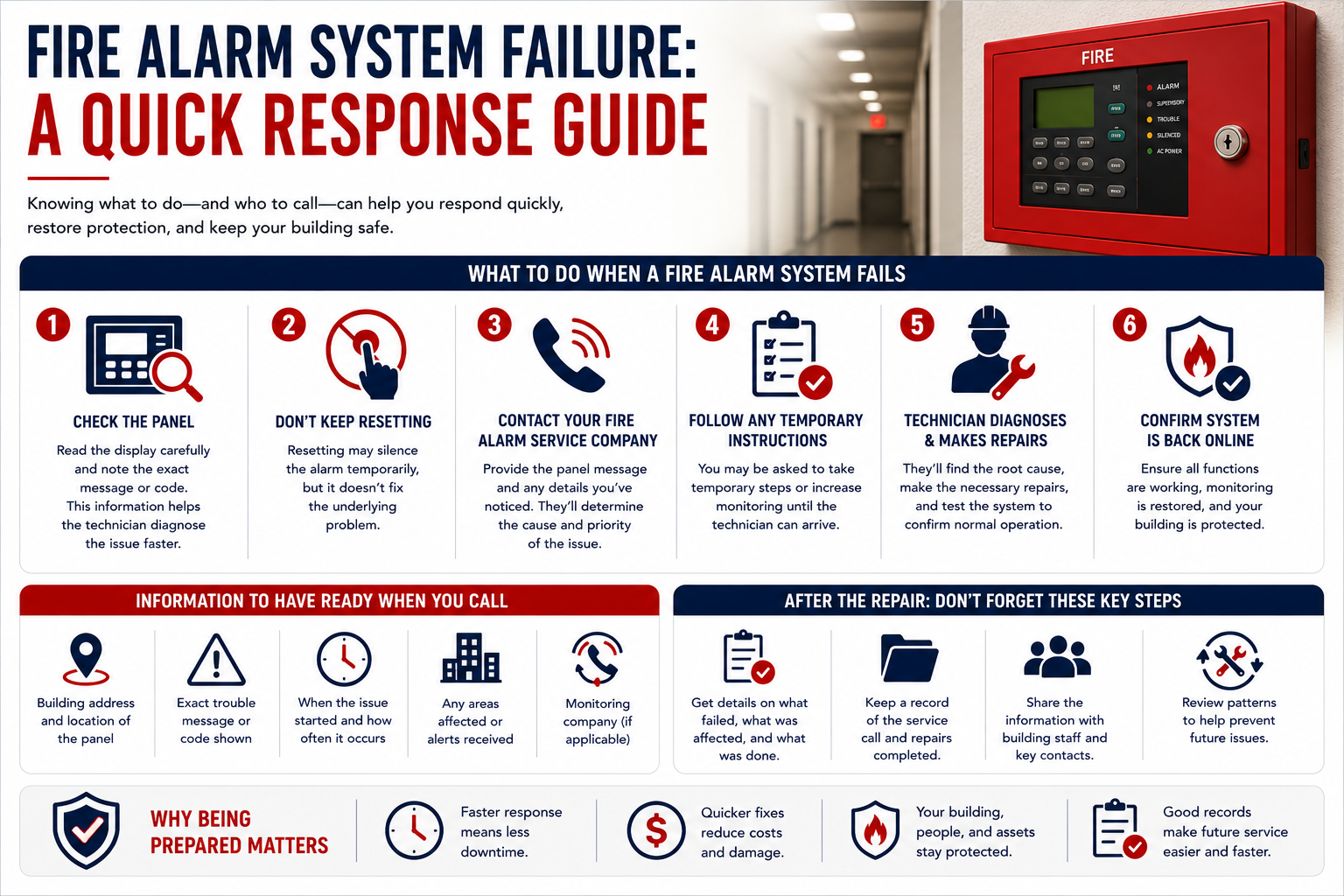
First, take a look at the panel.
If it is showing a trouble message, make note of what it says. That information can be useful when you call for service. What you do not want to do is keep resetting the panel every time the warning comes back.
A reset can clear the message. It does not necessarily clear whatever caused it.
If you manage a commercial building and you are not sure what the panel is telling you, call your fire alarm service company. A technician can figure out whether you are dealing with one faulty device, a problem on a circuit, or something more widespread.
That distinction matters. There is a big difference between replacing one bad detector and having part of the building’s alarm system offline.
When a Fire Watch May Be Required
This is where things can get a little more serious.
If enough of the fire alarm system is out of service, the building may need temporary measures in place until it is repaired. In some situations, that means a fire watch.
A fire watch is exactly what it sounds like. Designated people keep an eye on the affected parts of the building for signs of fire while the normal protection is unavailable. They also need to know what to do if they actually find something.
Whether you need one depends on what has failed, how much of the system is affected, the building itself, and the requirements in your area.
Do not guess on this one. If there is any question about what is required while the system is down, confirm it with the appropriate authority or your fire protection professional.
Who to Contact for Emergency Fire Alarm Repair
When you call for emergency service, the goal should not just be to make the panel stop beeping.
You want to know why it started beeping in the first place.
That may mean checking detectors, batteries, wiring, power supplies, circuits, or the panel itself. Fire alarm systems have a lot of pieces working together, and the device reporting the problem is not always the thing causing it.
Sometimes the technician finds something simple. Other times it takes a bit of troubleshooting to trace the problem back to its source.
If your alarm is monitored, there may be another phone call to make as well. Depending on what is happening with the system, your monitoring provider may need to know about the outage or repair.
By the end of the service call, you should have a pretty straightforward answer to three questions: What failed? What was affected? And what was done to fix it?
How to Reduce Downtime and Restore Protection Quickly
Obviously, nobody wants a fire alarm system sitting offline any longer than it has to.
But there is a difference between getting the warning off the screen and actually fixing the system.
This is where old service records can be surprisingly useful. If the same circuit had an issue six months ago, or a particular device has already been troublesome, that gives the technician somewhere to start. It can save a lot of unnecessary searching.
Keeping up with routine service helps too.
Batteries get old. Devices get damaged. Connections can cause problems. Some of these things can be spotted during a regular inspection instead of discovering them when the panel starts beeping on a busy Monday morning.
You cannot prevent every failure, but you can make some of them a lot less likely.
Fire Alarm Failure Response
| Situation | What It Could Mean | What to Do |
|---|---|---|
| Trouble signal on the panel | Something in the system needs attention | Have a technician check it |
| Part of the system is offline | An area of the building may have reduced protection | Find out what is affected and arrange service |
| Complete system failure | The building may have little or no functioning alarm protection | Arrange emergency service and confirm what temporary measures are needed |
| False alarms or faults keep returning | The underlying problem may still be there | Stop repeatedly resetting it and have the cause investigated |
| System has been repaired | Normal operation should be restored | Have the system tested and keep a record of the repair |
Be Prepared Before a Fire Alarm Problem Happens
There is a much easier time to figure out who your fire alarm company is than when the panel is already sounding.
Keep the service company’s number somewhere people can actually find it. Know where the inspection and repair records are. Make sure more than one person knows what to do if the system has a problem.
It sounds basic, but those little things save time when something actually happens.
The same goes for maintenance. If a technician can deal with an aging battery or troublesome device during a scheduled visit, that is a whole lot easier than finding out about it because the system has gone down.
And if the panel does start showing a problem, do not just reset it every morning and hope this is the day it stays quiet.
Find out why.